
 Info@raoscaffolding.com
  +91-9312069392
Buying Construction Equipment? Avoid These Costly Mistakes First
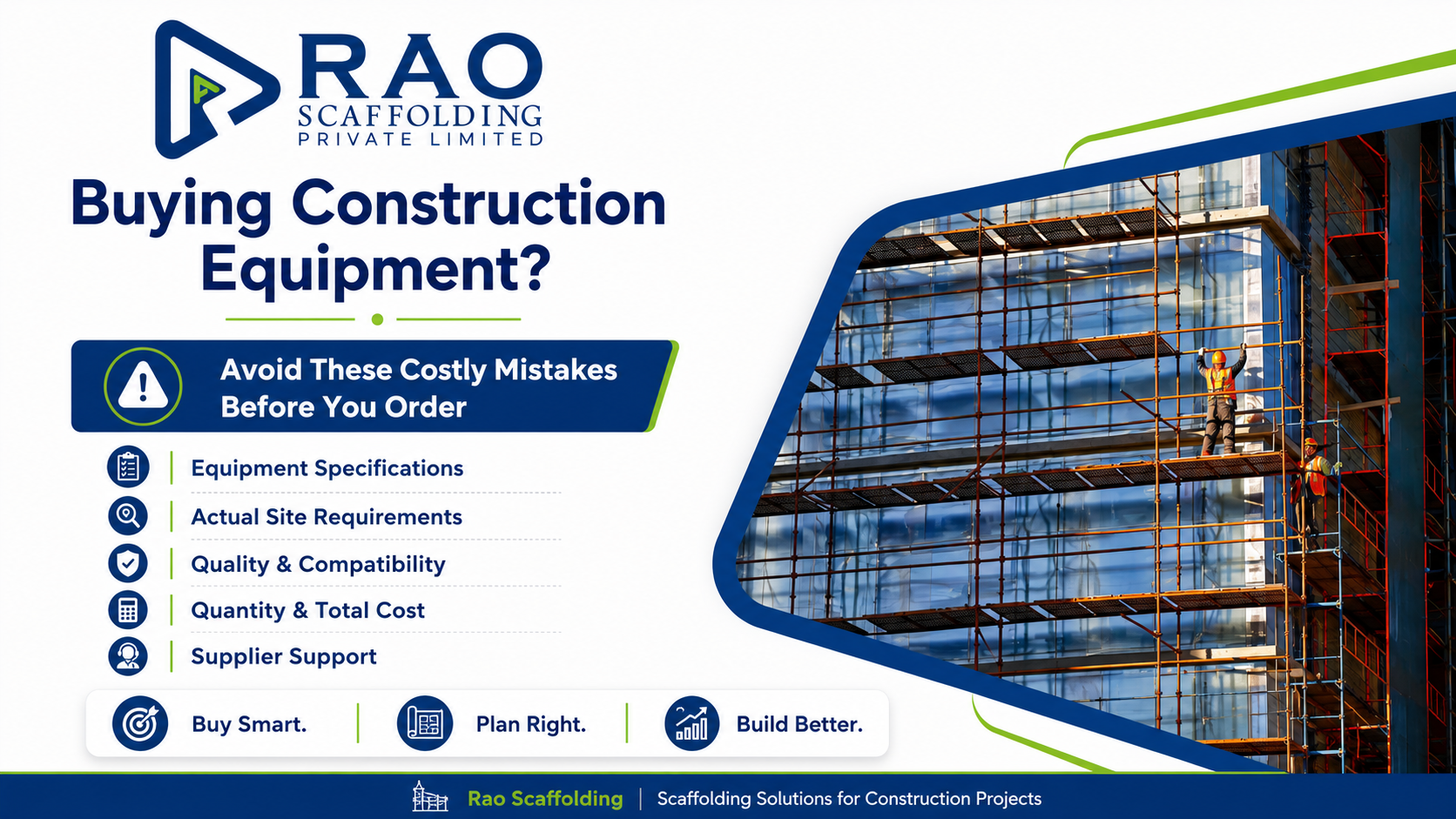
Buying construction equipment is not a decision that should be made simply by comparing prices from different suppliers. The right equipment has to suit the type of work, site conditions, expected workload, available space, and project duration. A machine, scaffolding system, or supporting equipment that looks economical at the time of purchase can become expensive if it causes delays, requires frequent repairs, does not fit the site properly, or cannot handle the work safely.
For contractors, builders, project managers, and procurement teams, the better approach is to understand exactly what the project requires before placing an order. If you are comparing Construction Equipment Suppliers in India, here are some of the mistakes worth avoiding before you make a purchase.
1. Choosing Equipment Only Because the Price Is Lower
A lower quotation can be attractive, particularly when a project has a tight procurement budget. But the cheapest equipment is not automatically the most economical option.
Consider the complete cost instead:
- Purchase price
- Transportation
- Installation or assembly
- Maintenance
- Replacement of damaged components
- Availability of spare parts
- Labour required to operate or assemble it
- Expected service life
For example, buying a low-cost scaffolding component may not save money if the material requires frequent replacement or does not provide the configuration required at the site.
A supplier’s quotation should therefore be evaluated against quality, specifications, durability, after-sales support, and suitability for the project, not just the final number.
2. Not Defining the Actual Site Requirement
One of the easiest mistakes is ordering equipment before the site requirement has been properly assessed.
A construction site may have restricted access, uneven ground, limited storage space, varying working heights, or areas where standard equipment cannot be used efficiently.
Before approaching Construction Equipment Suppliers in India, document the basic requirements of the project.
Think about:
- Type of construction work
- Working height
- Load requirements
- Available working area
- Ground conditions
- Access points
- Project duration
- Frequency of equipment movement
- Number of workers using the system
- Required quantity
This information allows the supplier to recommend equipment based on the actual application instead of simply offering whatever is readily available.
3. Buying More Equipment Than the Project Needs
Over-purchasing can tie up a significant amount of capital. A contractor may purchase equipment for the maximum possible requirement even though certain components or machines will only be required for a small portion of the project. This is particularly important for equipment that has limited use after project completion.
Before purchasing, ask:
Will we use this equipment repeatedly across future projects, or is it mainly required for this particular site?
If the requirement is temporary, construction scaffolding rental in India can sometimes be a more practical option than purchasing an entire scaffolding setup.Rental allows contractors to obtain the required equipment for the project period without committing the same amount of capital to equipment ownership.
4. Ignoring Equipment Compatibility
Construction equipment rarely works in isolation. Different components need to work together correctly. This is especially important with scaffolding and formwork systems, where dimensions, connections, load requirements, and supporting components need to match the intended configuration.
Before purchasing, confirm:
- Component dimensions
- Connection system
- Pipe or frame specifications
- Load capacity
- Accessories required
- Compatibility with existing equipment
- Replacement component availability
If you already have equipment at your site, tell the supplier exactly what you have before ordering additional material. A component that looks similar may not necessarily be suitable for your existing system.
5. Forgetting About Transportation and Storage
Equipment costs do not end when the supplier delivers the material. Large quantities of construction equipment require proper transportation, unloading, handling, and storage. Poor planning at this stage can create unnecessary expenses and site congestion.
Before ordering, determine:
Where will the equipment be delivered, unloaded, stored, and moved during the project? For scaffolding materials, for example, organised storage can make it easier for workers to identify required components and reduce unnecessary movement around the site. This becomes even more important on projects where working space is already limited.
6. Not Checking the Supplier’s Technical Capability
A supplier should be able to do more than provide a quotation. When dealing with Construction Equipment Suppliers in India, ask practical questions about the equipment being offered.
A reliable supplier should be able to clearly explain:
- Material specifications
- Intended application
- Available configurations
- Load-related information
- Component availability
- Maintenance requirements
- Delivery arrangements
- Replacement or additional component availability
This is particularly valuable when the project has unusual dimensions or demanding site conditions. A supplier who understands the application can often identify requirements that may not be obvious from a basic equipment list.
7. Treating Scaffolding as Just Another Purchase Item
Scaffolding deserves particular attention because it directly affects access and working conditions at height. The right scaffolding arrangement depends on factors such as working height, platform requirements, loading conditions, building configuration, ground conditions, and how frequently the structure needs to be altered or moved.
For a short-term project, purchasing a complete scaffolding inventory may not always make commercial sense. This is where construction scaffolding rental in India can be considered.
Rental can be useful when:
- The project is temporary
- Equipment requirements change during different stages
- You do not want to maintain a large inventory
- Storage space is limited
- Capital needs to remain available for other project expenses
However, rental should not mean compromising on material condition or suitability. The equipment supplied should be appropriate for the intended application and inspected before use.
8. Comparing Suppliers Without Comparing Specifications
Getting three or four quotations is good procurement practice. Comparing only the prices is not. Suppose Supplier A quotes ₹X and Supplier B quotes ₹Y. That comparison means very little unless both quotations are based on the same specifications and quantities.
Check whether the quotations cover the same:
- Material grade
- Dimensions
- Quantity
- Accessories
- Equipment configuration
- Delivery scope
- Rental period, where applicable
- Installation or related services
A cheaper quotation may simply contain less material or a different specification.Always compare like-for-like before deciding which supplier offers the better deal.
What Should You Check Before Buying Construction Equipment?
Before placing your final order, review these points:
- What exact work will the equipment be used for?
- Does its specification match the site requirement?
- What quantity is actually required?
- Will the equipment be needed for the entire project or only temporarily?
- Is renting more practical than purchasing?
- Are accessories and compatible components available?
- What are the transportation and storage requirements?
- Can the supplier provide additional equipment when required?
This simple assessment can prevent many avoidable procurement problems.
Why the Right Supplier Matters
The supplier you choose becomes an important part of the equipment procurement process. For contractors, the ideal supplier is not necessarily the one with the longest product list or the lowest quotation. It is the one that understands the application, provides clear specifications, maintains consistent quality, and can support the project when requirements change.
At Rao Scaffolding, the focus is on providing scaffolding solutions according to the practical requirements of construction projects. The company works with contractors and construction teams looking for dependable scaffolding products and rental solutions.
Whether a project requires scaffolding for a specific construction stage or a larger requirement needs to be planned, discussing the application and site conditions before finalising the equipment can help avoid unnecessary procurement problems.
Conclusion
Buying construction equipment should be treated as a project decision, not simply a purchasing decision. The right equipment needs to match the work being performed, the conditions at the site, the project schedule, and the expected usage. At the same time, the supplier needs to be capable of providing consistent material and support when requirements change.
Before accepting the cheapest quotation, compare the equipment specification, total cost, suitability, availability, and supplier support. And when the requirement is temporary, don’t automatically assume that purchasing is the only option. Depending on the project, construction scaffolding rental in India may offer a more practical way to access the equipment you need without carrying the full cost of ownership.
Frequently Asked Questions
1. What should I consider before buying construction equipment?
Start with the actual project requirement. Consider the type of work, site conditions, working height, load requirements, quantity, project duration, equipment compatibility, transportation, storage, maintenance, and supplier support.
2. How do I choose reliable Construction Equipment Suppliers in India?
Look beyond price. Check product specifications, quality consistency, technical understanding, availability of components, delivery capability, after-sales support, and the supplier’s ability to understand your project requirements.
3. Is construction scaffolding better to buy or rent?
It depends on the project. Buying can make sense when scaffolding will be used regularly across multiple projects. For temporary projects or changing requirements, construction scaffolding rental in India can reduce the need for a large upfront investment and long-term storage.
4. What should I compare when getting construction equipment quotations?
Compare the same specifications, quantities, accessories, delivery terms, rental duration where applicable, and support services. A lower quotation is not necessarily cheaper if it provides less material or a different specification.
5. Why is equipment compatibility important?
Incompatible components can create installation problems, reduce efficiency, and lead to additional procurement costs. Always confirm dimensions, connection systems, specifications, and compatibility before adding new equipment to an existing setup.