
 Info@raoscaffolding.com
 +91-9312069392
Cuplock Scaffolding vs H Frame Scaffolding: Which Is Better for High-Rise Construction?
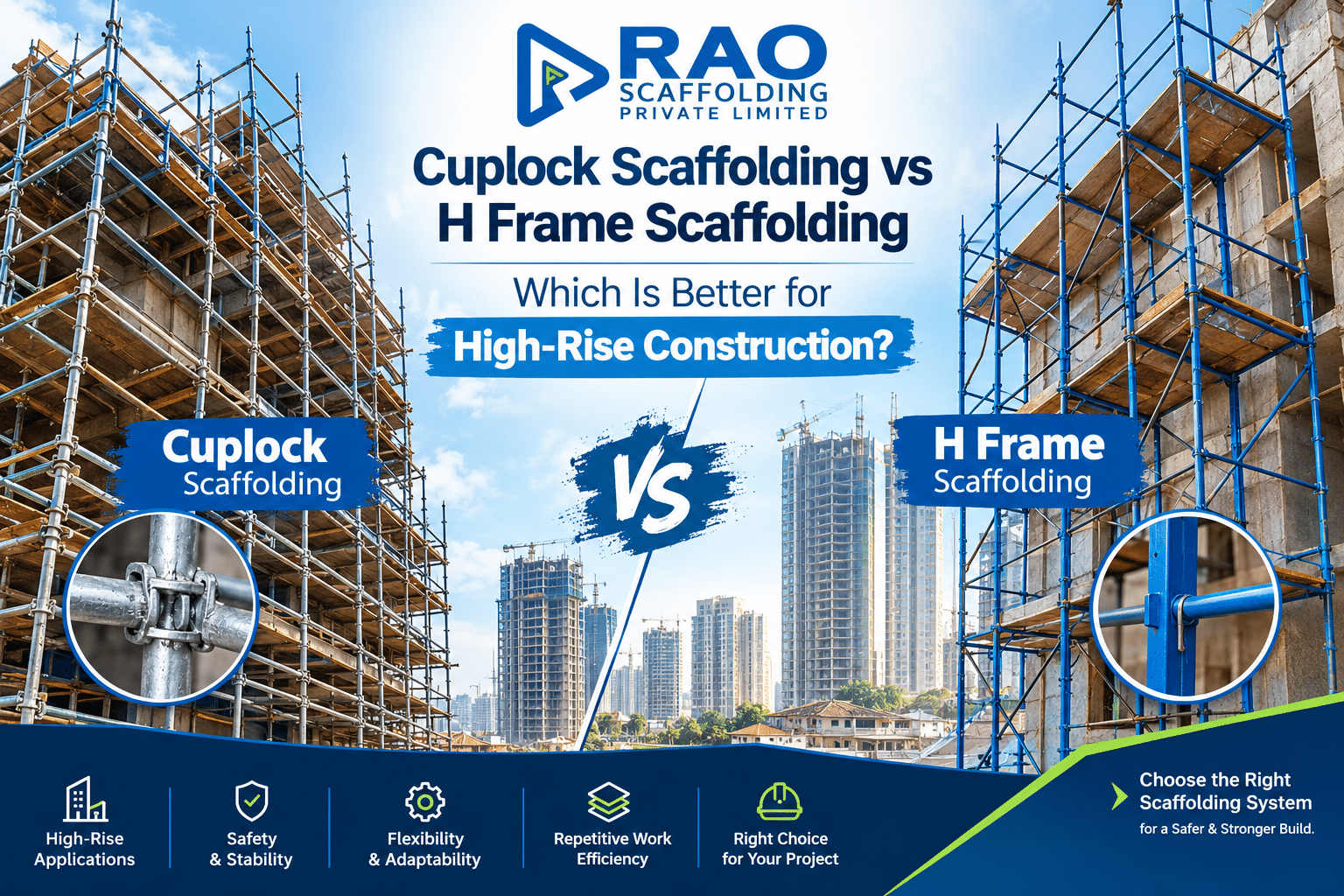
Choosing scaffolding for a high-rise project is not as simple as taking the lowest rental quote. A system may look suitable when the work starts, but things can change once construction moves to the upper floors.
On a high-rise site, the work does not stay the same throughout the project. One floor may be going through brickwork while another is ready for plastering or finishing. Workers need access at different heights, materials have to be moved around the site, and in some areas the scaffolding may need to be changed to suit the work.
This is where the choice of scaffolding starts to matter.
Cuplock scaffolding and H Frame scaffolding are both used on construction sites in India. But they are not the same system, and what works well on one project may not be as convenient on another.
H Frame scaffolding can be a practical option when the building has a fairly regular layout and similar work is being repeated from one floor to the next. Cuplock scaffolding gives more room to adjust the arrangement when the working levels or site requirements are different.
So, which one should you choose for a high-rise project?
There is no fixed answer. The building layout, type of work, working height, load requirements, available space and the way the scaffolding will be shifted during construction all need to be considered. Looking at these things first will give you a much better idea of whether Cuplock or H Frame is the right fit for your project.
Cuplock Scaffolding vs H Frame Scaffolding at a Glance
| Factor | Cuplock Scaffolding | H Frame Scaffolding |
| System type | Modular system scaffolding | Frame-based scaffolding |
| Flexibility | High | Moderate |
| Multi-level applications | Excellent | Good |
| Complex building profiles | Better suited | Less flexible |
| Repetitive construction | Excellent | Excellent |
| Assembly | Requires correct system assembly | Relatively straightforward |
| Adaptability around obstacles | Better | More limited |
| High-rise applications | Highly suitable | Suitable depending on project |
| Rental applications | Commonly used | Commonly used |
| Best suited for | Complex and multi-level work | Repetitive building work |
The table gives a quick comparison, but the real decision comes down to how the scaffolding will be used.
What Is Cuplock Scaffolding?
Cuplock scaffolding is a modular scaffolding system designed around vertical standards and horizontal ledgers that connect through cup-and-wedge joints.
Its biggest advantage is flexibility.
Instead of relying only on fixed frame dimensions, the system can be arranged to create working platforms at different levels and accommodate different construction requirements.
For high-rise construction, this can become particularly useful because different parts of the building may require access for:
- External plastering
- Painting
- Brickwork
- Concrete-related work
- Façade activities
- MEP installation
- Maintenance work
- Material handling
- Finishing activities
The modular nature of Cuplock scaffolding makes it easier to configure the system according to the work area rather than treating every elevation as identical.
This is one reason contractors looking for Cuplock scaffolding suppliers in India often consider the system for larger and more demanding construction projects.
What Is H Frame Scaffolding?
H Frame scaffolding, also called H-frame or frame scaffolding, consists primarily of prefabricated frames connected using horizontal members and scaffolding accessories to create working platforms.
Its straightforward configuration makes it popular for building construction where the work layout is repetitive.
For example, a project with multiple floors having similar layouts can benefit from a standardized frame system because the same type of components can be repeatedly installed and shifted as construction progresses.
H Frame scaffolding is commonly considered for applications such as:
- Residential building construction
- Commercial buildings
- Brickwork
- Plastering
- Painting
- External finishing
- General construction access
However, when the building geometry becomes more complicated or the working arrangement changes significantly from one area to another, the flexibility of a modular system can become more valuable.
Which Scaffolding Is Better for High-Rise Construction?
There is no single answer for every high-rise project.
However, Cuplock scaffolding generally has an advantage when flexibility, multiple working levels and adaptability are major requirements.
H Frame scaffolding can still be an effective choice where the building design and work sequence are repetitive and the frame dimensions match the project requirements.
The right decision should be made after considering five important factors.
1. Building Design and Geometry
The shape of the building has a direct effect on scaffolding selection.
A simple building elevation with repetitive floor layouts may work efficiently with H Frame scaffolding.
But high-rise buildings can include:
- Setbacks
- Projections
- Balconies
- Different floor layouts
- Columns at varying locations
- Service areas
- Irregular façades
- Changes in working elevations
In such situations, Cuplock scaffolding can provide greater flexibility because its modular components can be arranged for different working requirements.
For complicated building profiles, flexibility can be more valuable than simply choosing the system with the lower initial rental cost.
2. Working Height and Multiple Levels
High-rise construction involves continuous work at different elevations.
Scaffolding may need to provide access for several activities while allowing the site team to move between working levels efficiently.
Cuplock scaffolding is particularly useful where multiple levels and different platform arrangements are required.
However, height alone should not determine the selection.
The scaffolding arrangement must be planned according to the actual application, loading, access requirements and applicable safety practices.
A professional scaffolding supplier in India should be able to understand these requirements before recommending the system.
3. Speed of Installation and Shifting
Construction schedules are heavily dependent on productivity.
If scaffolding takes too long to install, modify or shift, it can affect the sequence of other activities.
H Frame scaffolding has an advantage in projects where repeated frame configurations are required. Once the crew becomes familiar with the installation process, repetitive work can be handled efficiently.
Cuplock scaffolding, meanwhile, can be advantageous when the scaffolding arrangement changes frequently because the modular components provide more configuration options.
Therefore, the question should not simply be:
“Which system installs faster?”
Instead, ask:
“Which system will require less modification throughout my project?”
That question can lead to a much more useful comparison.
4. Site Conditions and Obstructions
Construction sites rarely remain perfectly clear.
Columns, beams, projections, equipment, material storage areas and access routes can affect where scaffolding can be positioned.
This is another area where Cuplock scaffolding can have an advantage.
Its modular arrangement can make it easier to develop configurations around different site requirements.
H Frame scaffolding is still practical, but its standardized frame geometry may become restrictive when the site requires frequent adjustments.
For a high-rise project with a complicated façade or changing working areas, this difference can become important.
5. Total Project Cost, Not Just Rental Price
One of the biggest mistakes contractors make when comparing scaffolding on rent is looking only at the quoted rental rate.
The cheaper system on paper may not necessarily be cheaper after considering the entire project.
The actual cost can also be affected by:
- Installation and dismantling requirements
- Labour
- Transportation
- Number of components required
- Modification requirements
- Shifting between floors
- Project duration
- Material availability
- Damage or replacement
- Storage and handling
For example, if a low-cost scaffolding arrangement requires frequent modifications, the additional labour and downtime can reduce the expected savings.
This is why contractors should compare the total cost of using the scaffolding system, rather than comparing only the per-day or per-month rental rate.
Cuplock Scaffolding: Where It Makes More Sense
Cuplock scaffolding can be a strong choice when your project requires adaptability.
It may be particularly suitable for:
High-rise buildings
Multiple working elevations and changing construction requirements can make modular scaffolding useful.
Industrial construction
Industrial structures often have complicated layouts, equipment zones and varying access requirements.
Infrastructure projects
Large infrastructure work can involve changing work areas where a flexible scaffolding arrangement is beneficial.
Façade and finishing work
Different sections of a building may require different access arrangements.
Projects with changing platform requirements
When the same scaffolding needs to serve different construction activities, modularity becomes valuable.
H Frame Scaffolding: Where It Makes More Sense
H Frame scaffolding can be a practical option when simplicity and repetitive construction are the priorities.
It may work well for:
Residential buildings
Where floors and elevations are relatively repetitive, standardized H Frames can be efficient.
Brickwork and plastering
For straightforward external wall activities, H Frame systems can provide a practical working arrangement.
Repetitive floor layouts
If the same arrangement is repeated floor after floor, standardized frames can simplify installation and shifting.
Projects with straightforward access requirements
Where there are fewer variations in elevation and fewer obstructions, the flexibility of a modular system may not always be necessary.
Cuplock vs H Frame: Which One Should You Rent?
If you are searching for scaffolding on rent, don’t start with the question:
“What is the cheapest scaffolding?”
Start with:
“What scaffolding system matches my construction work?”
Choose Cuplock when:
- The building has complex elevations.
- Multiple working levels are required.
- The scaffolding arrangement will change during construction.
- Flexibility is important.
- The project involves industrial or infrastructure work.
- Different access configurations are expected.
Consider H Frame when:
- The building layout is repetitive.
- Standard frame dimensions suit the project.
- The work is primarily brickwork, plastering or finishing.
- The scaffolding arrangement will remain relatively consistent.
- Straightforward installation is a priority.
What Should You Ask a Scaffolding Supplier Before Renting?
Whether you choose Cuplock or H Frame, don’t finalize the order based only on a price quotation.
Ask the supplier:
1. What quantity of scaffolding will my project require?
A supplier should understand the approximate working area and project requirements before giving a meaningful recommendation.
2. What components are included in the quotation?
Check whether the quotation covers the required standards, ledgers, frames, platforms, base components and other necessary accessories.
3. Is transportation included?
Transportation can significantly affect the actual rental cost, particularly for large quantities.
4. What is the condition of the material?
Inspect material conditions before accepting a large rental quantity. Bent, heavily damaged or poorly maintained components can create problems during installation.
5. How will the scaffolding be installed and dismantled?
Clarify responsibilities between the supplier, contractor and site team.
6. Can the supplier provide additional material when required?
High-rise projects can change as construction progresses. Material availability can become important when the site requires additional working platforms or modifications.
7. Is the system appropriate for the intended load and application?
Scaffolding should be selected and erected according to the actual project requirements and applicable safety requirements. Never assume that a particular scaffolding system is automatically suitable for every loading condition.
Why Choosing the Right Scaffolding Supplier Matters
The quality of the scaffolding system is only one part of the equation.
The supplier’s ability to provide the right quantity, suitable components and consistent material availability can have a direct impact on construction operations.
For contractors comparing Cuplock scaffolding suppliers in India, important evaluation points include:
- Product quality
- Material condition
- Component availability
- Technical understanding
- Delivery capability
- Rental flexibility
- Project-specific requirements
- Replacement support
- Communication and response time
A reliable supplier should focus on the requirements of the project rather than simply pushing whichever scaffolding material is currently available.
Cuplock Scaffolding or H Frame: The Final Verdict
So, which is better for high-rise construction?
For projects where the building has complex elevations, multiple access requirements and changing scaffolding configurations, Cuplock scaffolding is generally the more flexible option.
For repetitive building construction where standardized frame arrangements are suitable, H Frame scaffolding can offer a straightforward and practical solution.
The better system is therefore not necessarily the one with the lowest rental price or the one used most frequently. It is the system that provides the right combination of access, adaptability, productivity, material availability and overall project cost.
If you are planning to rent scaffolding for a high-rise project, evaluate the building design, working height, construction sequence and expected material requirement before making the final decision.
Rao Scaffolding provides scaffolding solutions for construction requirements, including Cuplock scaffolding and scaffolding on rent. Discuss your project requirements with the supplier before finalizing the quantity and system so that the scaffolding arrangement matches the actual work.
Conclusion
Choosing scaffolding for a high-rise project is a construction decision, not simply a rental decision.
Cuplock scaffolding offers flexibility where building geometry and working requirements change, while H Frame scaffolding can be highly effective for repetitive and straightforward construction work.
Before ordering, consider how the scaffolding will actually be used throughout the project—not just how much it costs on the quotation.
If your project is moving to higher floors and you are unsure whether you need Cuplock scaffolding, H Frame scaffolding, or scaffolding on rent, talk to Rao Scaffolding before placing your order.
Tell us about your project type, working height and approximate requirement. We can help you work out what type and quantity of scaffolding will make sense for the job—so you don’t end up paying for material you don’t need or falling short when the work moves ahead.
Planning Your Next Phase? Talk to Rao Scaffolding Today.
Frequently Asked Questions
1. Is Cuplock scaffolding better than H Frame scaffolding for high-rise buildings?
Cuplock scaffolding can be better suited to high-rise projects that require flexibility, multiple working levels and changing configurations. H Frame can be a practical choice when the building layout is repetitive and standardized.
2. Which scaffolding is more suitable for complex building structures?
Cuplock scaffolding is generally more adaptable to complex structures because its modular components allow different arrangements according to the working requirements.
3. Is H Frame scaffolding suitable for high-rise construction?
Yes. H Frame scaffolding can be used for high-rise construction where the building design, working arrangement and project requirements are compatible with the frame system. The suitability should be assessed for the specific project rather than based on height alone.
4. Should I buy or rent scaffolding for a high-rise project?
Renting can be practical when scaffolding is required for a specific project or limited construction period. Buying may make more sense for contractors who have regular projects requiring the same equipment. Compare the expected usage, project duration, storage, transportation and maintenance costs before deciding.
5. How do I choose Cuplock scaffolding suppliers in India?
Compare suppliers on material quality, component availability, project experience, delivery capability, rental terms and their ability to understand your actual construction requirements. Do not compare suppliers only on rental price.
You may also like – MS Scaffolding Suppliers in Bangalore: What Contractors Should Know Before Buying